
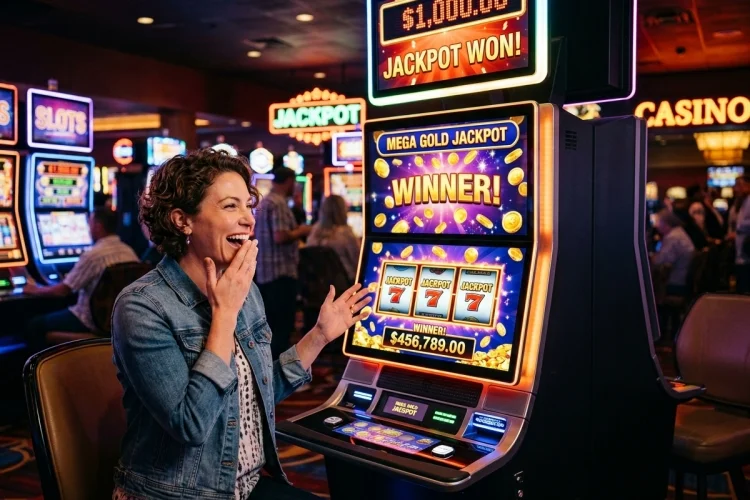
How Are Jackpot Slot Winners Selected? RNGs, Rules and Networks
A jackpot counter can climb for days or weeks before suddenly dropping back to its starting value. When that happens, one obvious question comes to mind: who decided which player received the prize?
So, How Are Jackpot Slot Winners Selected? In properly regulated online slots, the answer usually involves predetermined game rules, random number generation, and jackpot-control systems rather than a person choosing a player.
Different jackpots use different triggers, though. Some require specific symbols, while others rely on randomly generated mystery events or hidden jackpot thresholds.
Jackpot Winners Are Selected by the Game Rules
There is no universal selection method used by every jackpot slot.
A game may award its jackpot after a particular symbol combination appears, after a bonus feature produces the required result, or when an independent jackpot mechanism generates a qualifying event.
What matters is that the method should follow the rules shown to players.
The UK Gambling Commission requires gambling systems to process and settle games according to their published rules. Its technical standards also require random games to produce outcomes according to their established probabilities and paytables.
In other words, a regulated jackpot should not involve casino staff manually deciding that one customer deserves the prize.
How RNG-Based Jackpot Selection Works
Random Number Generators, or RNGs, play an important role in many online slot results.
An RNG continuously or repeatedly produces numerical outputs. Those numbers are mapped to game outcomes according to the slot’s mathematical model—for example, reel symbols, bonus triggers, or another qualifying event.
UK Gambling Commission standards require RNG output to be acceptably random and unpredictable. They also prohibit adaptive behaviour that changes outcome probabilities based on previous payouts or player results.
That means losing several rounds does not normally make your personal account “due” for a jackpot.
Likewise, winning recently does not automatically reduce your chance on the next qualifying game cycle.
Some Jackpots Are Triggered by Winning Symbols
One common jackpot method is easy to understand: the player must achieve a specified game result.
It might involve a particular set of jackpot symbols, a bonus wheel, or another combination described in the paytable.
Gaming Laboratories International’s current GLI-12 standard recognizes that progressive jackpots can be awarded through winning symbols as well as through other trigger criteria.
In this model, the winner is essentially the player whose qualifying game round produces the required outcome.
The RNG and game mathematics determine whether that combination appears. The visual jackpot animation occurs after the system has identified the result.
The exact proces can vary considerably, so the rules should always be checked instead of assuming every progressive slot works the same way.
Mystery Jackpots Use a Different Selection Method
A mystery jackpot does not necessarily require a visible jackpot symbol combination.
GLI-12 says mystery-triggered jackpots may activate from a random event on an individual play or when the progressive amount reaches a randomly selected hidden trigger threshold.
For a hidden-threshold system, the trigger is selected randomly when the jackpot begins or resets. Under the GLI standard, it lies between the reset value and the jackpot ceiling and remains unknown.
Imagine a jackpot resets at $10,000 and has a $20,000 maximum threshold.
The system might secretly select $17,462.83 as the trigger. Eligible play continues to contribute to the jackpot, and the qualifying event that causes the jackpot to reach that hidden point can produce the winner according to the system’s rules.
This type of mechanic is sometimes associated with “must-hit-by” style jackpots, although implementations can differ.
How Progressive Jackpot Networks Affect Selection
A progressive jackpot increases as qualifying wagers contribute to its prize pool.
The UK Gambling Commission defines a progressive jackpot as an incremental prize that grows through contributions from money staked in the game.
Some jackpots belong to one game only. Others are linked across many games, casinos, or jurisdictions.
Games Global, for example, operates progressive networks that include brands such as WowPot and Mega Moolah. Its WowPot network has been offered across multiple linked slot titles.
A central jackpot controller can track contributions, the current pool, participating games, and qualifying triggers.
This larger network increases the number of participating game rounds, but the eventual winner must still satisfy the trigger and eligiblity conditions defined by the system.
Does Your Bet Size Affect Jackpot Chances?
Sometimes – but not always.
Jackpot rules may require a minimum qualifying wager or may change eligibility or probability according to the amount contributed. Other systems offer the same trigger opportunity at multiple eligible stake levels.
UKGC standards require jackpot rules to explain how the prize is funded and determined. If a customer contributes to a jackpot pool, that customer should generally be eligible to win while playing according to the jackpot rules.
GLI-12 similarly addresses linked jackpots and wager denominations, requiring equivalent odds adjusted for monetary wager unless another arrangement is clearly disclosed.
The useful takeaway is simple: never assume that maximum stake is required – or that it gives identical advantages across every game. Read the specific jackpot rules.
What Happens When the Jackpot Is Triggered?
Once a qualifying event occurs, the system must recognize the trigger and associate it with the winning play.
GLI-12 states that jackpot winners should be notified by the end of the game in progress or, when an external jackpot controller is involved, within 30 seconds after the trigger is recognized.
Smaller awards may be credited automatically.
A very large jackpot may require additional intervention before payment, particularly where jurisdictional, tax, payment, or verification requirements apply.
That does not mean the winner is being selected afterward. The winning event has already occurred; the following steps concern verfication and payment.
What If Two Players Trigger the Jackpot Almost Together?
Large linked networks can process many rounds in a short period, creating another question: what if two players appear to hit the same jackpot at nearly the same time?
GLI-12 requires jackpot controllers to be capable of identifying and recording trigger order when possible. The first qualifying trigger receives the jackpot under that approach.
If an exact simultaneous trigger is possible and order cannot be distinguished, technical standards call for rules addressing how the prize is handled.
The UK Gambling Commission similarly requires jackpot rules to explain what happens when multiple players simultaneously or apparently simultaneously trigger the same jackpot.
Independent Testing Helps Check the System
Regulated jackpot software is not supposed to rely only on a developer saying, “Trust us.”
The UK Gambling Commission’s testing strategy requires approved third-party test houses to examine areas including RNG output, mapping, mathematics, source code, game rules, and progressive jackpot trigger functionality before relevant products are released.
The goal is to confirm that the jackpot behaves according to its published rules and expected mathematics.
This technical testing is an important part of the overall system because players cannot personally inspect the software behind every spin.
How Are Jackpot Slot Winners Selected? It depends on the game’s rules. A winner may be determined by an RNG-generated symbol result, a mystery event, or a randomly selected hidden threshold within a progressive system.
Instead of looking for patterns in previous spins, check the official jackpot rules, eligibility requirements, and trigger conditions before playing any jackpot slot.